

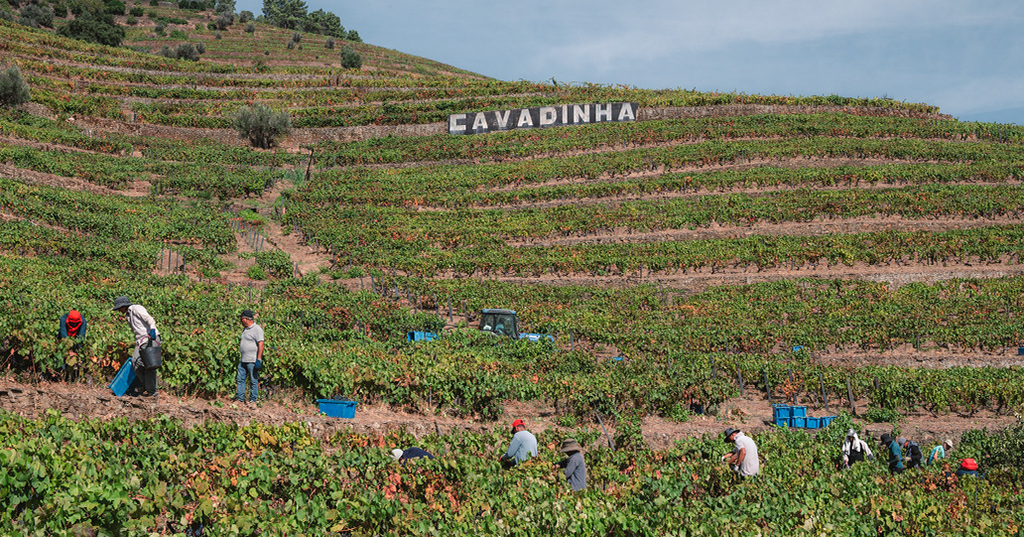
2026 Harvest Report
'A Game of Two Halves' | 2026 Harvest Report
Following 2025, one of our smallest and shortest Douro vintages in decades, 2026 was a harvest of two halves. After the earliest growing cycle we have ever recorded, we began picking white grapes on August 17th, a full week ahead of any previous vintage. For the first three to four weeks of the harvest everything pointed to an exceptional year, with above-average yields, beautifully balanced sugars and acidity, and Touriga Nacional picked at its peak. Then came Portugal’s hottest September since records began in 1931. Dehydration on the vine and the highest Baumés I can remember turned a near-perfect start into a seven-week test of endurance. The crop ended close to average in size, and the wines that emerged have tremendous concentration and colour, and quality above average overall.
The earliest growing cycle
The early start came as no surprise. The wettest winter in a decade, followed by a very warm and moderately wet spring, accelerated vegetative growth, and both flowering and pintor (veraison) were the earliest we have ever recorded.
By the end of June we had 739mm of accumulated rainfall, against a 30-year average of 545mm. Yet well above-average temperatures from April to June drove such vigorous growth that soil water content fell from 24% at the end of May to 15.9% a month later. Negligible rain in June and none at all in July did nothing to reverse the trend.
A promising start
A nine-day heatwave from August 10th to 18th was followed by welcome relief: five days of generous rain towards the end of the month (double the August average at Bomfim), refreshing the vines, easing temperatures and allowing ripening to move on.
This was our cue to begin picking the reds in earnest, starting with Sousão, Tinta Barroca and Alicante Bouschet, then the Touriga Nacional from the second week of September, just as it reached phenolic ripeness and the vintage entered its prime. Our only concern was the considerable overlap in ripening between the Nacional and the Touriga Franca, which called for careful planning to pick both at their optimum.
A vintage turned on its head
Then fortunes changed. The first of two September heatwaves set the tone for a month that was hot and dry almost throughout. Grapes began to dehydrate on the vine, and what had been a measured harvest became a race against the heat, as we hurried to bring in each block before it lost further ground. Yields began to fall sharply.
From mid-month extreme daytime heat was compounded by a string of tropical nights, most unusual for late September. We alternated between our best blocks of Nacional and Franca to limit further losses. In my career as a winemaker, I don’t remember such high Baumés in the lagares, sometimes above 15º, and we watched the fermentations very closely. On the plus side, the wines show tremendous concentration and fabulous colour.
October’s weather data confirmed the scale of it, with the EU’s Copernicus service ranking it the joint-warmest September on record for Western Europe. The last grapes reached Bomfim on September 29th and Quinta de Roriz the following day, closing one of our longest vintages in years at nearly seven weeks.
Portalegre | Alentejo – Quinta da Fonte Souto
As in the Douro, a very wet winter and spring with above-average temperatures brought the cycle forward, and a hot, dry summer, with many days close to 40°C and runs of tropical nights, placed the vines under real strain. We started picking on August 3rd, our earliest ever vintage at Fonte Souto, and had the whites in by September 9th. Night harvesting was once again essential, for grapes and pickers alike.
September’s heat made the reds far harder going: dehydration, stalled maturations and high sugars cut yields considerably, and at times we had to hold off picking for several days before finishing on September 30th. The results are very fresh, aromatic whites with good ageing potential, and reds with a mature profile, lifted aromas, rounded tannins and good acidity, further proof of a terroir that delivers quality even in the most demanding years.
Monção e Melgaço | Vinho Verde – Casa de Rodas
At Casa de Rodas the vintage arrived an unprecedented three weeks early, on August 24th, as the advanced cycle and hot, dry summer brought on very early ripening. Despite the heat, the Alvarinho grapes arrived in excellent health, with balanced maturations. In this, our fourth harvest here, production remains modest, as much of the estate has been replanted and the vines are still young; our focus is on nurturing them to deliver quality for many years to come.
Two vintages in one
We have adapted well to climate change over the last decade, but 2026 is perhaps the vintage in which we have felt its effects most keenly. A harvest that began with great promise, and gave us some very fine early wines, became from its halfway point one of the most demanding we have faced.
Yet overall, 2026 is a vintage of above-average quality. The wines carry the imprint of that hot, dry September in their concentration and colour and, despite the exceptionally high Baumés of the later pickings, many show surprisingly good acidity for their level of ripeness.
Charles Symington, Head Winemaker
Quinta do Bomfim, 21st October 2026
