

Viticulture Bulletin – Winter 2026
Viticulture Bulletin
November 2025 – March 2026
Synopsis
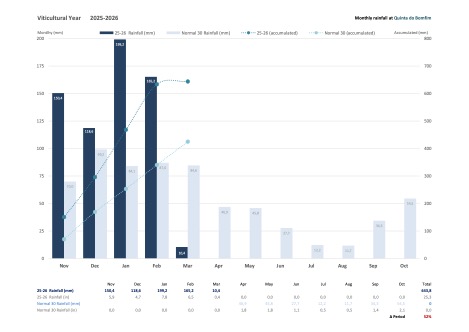
In stark contrast to last year, the winter of 2026 was exceptionally wet, in fact it was easily the wettest of the last decade. Accumulated winter rainfall at Bomfim reached an incredible 643.8mm. In other words, it rained almost as much in the first 5 months (November ’25 – March ’26) of this viticultural year as it does in an entire year: 658mm (30-year average from the Bomfim weather station records). November and January saw more than double the monthly average rainfall, while December and February were also very wet. Only March saw a sudden drop in this pattern with just 10.4mm of precipitation compared to the monthly 30-year average of 84.6mm. The season was generally mild with mainly above average temperatures (Douro), despite some cold spells in November and January.
Fig.1: Quinta do Bomfim – Viticultural Year 2025/26 – Monthly rainfall
November was exceptionally wet in the Douro with rainfall across all our quintas being double or more than double the average for the month at Ataíde, Vale Coelho, Vesúvio, Canais, Bomfim and Cavadinha. At Casa de Rodas in Monção & Melgaço it was almost three times the monthly average (equivalent to one third of a year’s total rainfall) and 45% more than expected at Fonte Souto in Portalegre. In the Douro, apart from the Douro Superior, temperatures were fractionally above normal for the month, whilst in Monção & Melgaço and in Portalegre it was cooler than usual.
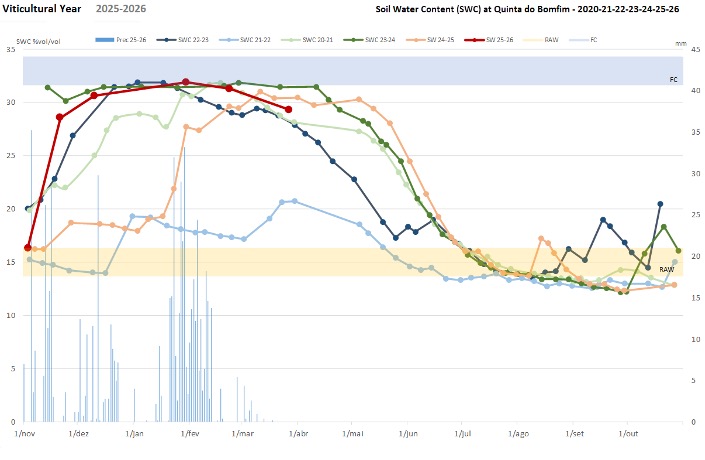
Although not quite as wet as November, all our weather stations (Douro, Alentejo and Minho) recorded above average rainfall during December. At Casa de Rodas, between November and December, the property had recorded just over 50% of a complete year’s precipitation. As in the previous month, temperatures in the Douro, excepting the Douro Superior, were above average, by as much as +2°C at Malvedos. In Monção and Melgaço and in Portalegre, temperatures were fractionally below the monthly mean. By the year’s end, soil water availability in the Douro was 30.6%, very close to field capacity and the second highest reading of the last decade (at this stage in the season).
January was another exceptionally wet month with every one of our Douro weather stations (bar Ataíde) recording at least more than double the monthly rainfall. At Cavadinha, it rained almost three times more than what would be considered normal. It was equally wet in the Minho and Alentejo. Notwithstanding some snowfall on higher ground in the Douro at the end of the month (for example, at Quinta das Netas), all our weather stations recorded above average temperatures with the exception of Tapadinha in the Douro and Fonte Souto in the Alentejo. Fortunately, we were spared the worst impacts of storm Kristin (January 28), which brought very destructive hurricane force winds to central Portugal (156km/h in Leiria).
February was very similar to January, with practically more than double the average monthly rainfall recorded across all our properties. Between the third week of January and the middle of February, it rained consecutively for 24 days. Again, Cavadinha topped the scales with almost three times the precipitation (226mm compared to the monthly average of 79mm). It was also at Cavadinha that the biggest positive temperature deviation was recorded: +2.6°C above the average for the month. All other weather stations also recorded positive temperature departures from the mean.
March broke the humid pattern of the previous four months with a substantial reduction in precipitation across our Douro quintas, all weather stations recording well below average rain for the month. March was characterised by pronounced variability in air temperatures, with periods of unusually high maximum temperatures in most areas (around 25°C) contrasting with lows of 2°C at Ataíde and Canais. The combination of very warm temperatures and high soil water content brought forward budbreak across most of our vineyards. This encouraged rapid vine shoot growth and points to the high probability of very early flowering (possibly the earliest ever).
Budbreak
At Bomfim, budbreak for the Touriga Franca, occurred on March 10, which was 17 days earlier than in the previous year and 9 days earlier than average. At Ataíde, budbreak was observed on March 12, 15 days earlier than 2025 and a week ahead of the average date.
Given the abundant winter rainfall, it is not surprising that we had 29.32% soil water content (measured by our probes at Bomfim) at the end of March — a good position to be in. This is the third highest reading at the end of winter since we started recording these parameters.
Fig.2: Quinta do Bomfim – Viticultural Year 2025/26 – Soil Water Content.
Fernando Alves, Miguel Potes and Joana Valente · May 7, 2026
